
Categories
Tips & Advice, North East Georgia, Market Trends, Mortgage & FinancingPublished September 1, 2026
How Interest Rates Actually Affect Your Monthly Payment

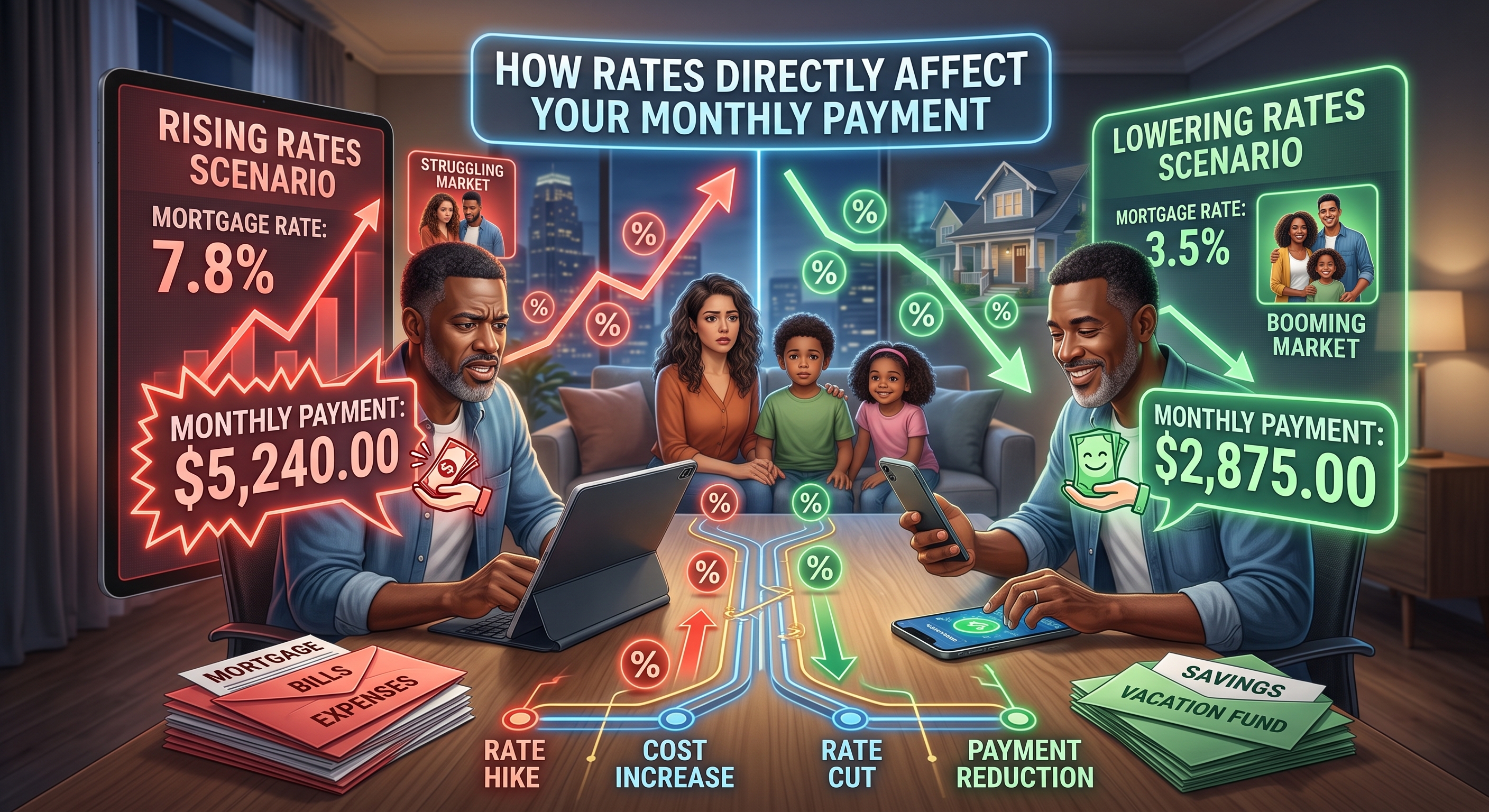
If you are shopping for a home in Northeast Georgia, you have probably heard a lot about mortgage rates. But what does a rate actually mean for your monthly budget? On a $300,000 loan, a difference of just 1% changes the payment by close to $200 a month, which is why understanding the numbers matters before you decide what price range feels comfortable.
As of August 27, 2026, Freddie Mac reported an average 30-year fixed mortgage rate of 6.66%, compared with 6.65% the previous week and 6.56% one year earlier.
Keep in mind that this survey reflects conventional, conforming loans for borrowers putting 20% down. It is a national average, not a quote. Your actual rate can vary based on credit, loan type, down payment, lender and other factors.
So how does that rate translate into dollars?
Imagine you are purchasing a $375,000 home with 20% down. That leaves a $300,000 mortgage.
Using a 30-year fixed loan and looking only at principal and interest:
The rates above and below 6.66% are shown for illustration, to give you a sense of how much movement in either direction is worth.
The difference between 5.66% and 6.66% is roughly $194 per month, or about $2,328 per year.
And remember, this is only principal and interest. Your total monthly housing payment could also include property taxes, homeowners insurance, mortgage insurance and HOA fees, depending on the property and loan.
That is why looking at the interest rate by itself does not tell the whole story.
On a $300,000, 30-year mortgage at 6.66%, the principal and interest payment is approximately $1,928 per month. If you made that payment for the full 30 years without refinancing or paying the loan off early, you would pay roughly $694,000 in total. About $394,000 of that is interest.
That does not mean you should avoid buying when rates are higher.
It means you should understand what you are agreeing to.
Your interest rate, purchase price, down payment and loan term all work together to determine your payment.
This is where it can be tempting to stretch your budget.
If rates fall, your purchasing power may improve because the same loan amount could have a lower monthly payment. But that does not automatically mean you should increase your home price.
A lower payment could instead give you an opportunity to:
Those are two very different numbers.
You may have heard someone say, "Just buy now and refinance later."
The reality is more nuanced.
Mortgage rates can move higher or lower after you purchase. If rates fall enough in the future, refinancing may become something worth considering. However, refinancing is not guaranteed, and it comes with its own costs and qualification requirements.
That means you should be comfortable with the payment you are agreeing to today, rather than purchasing a home based entirely on the hope that rates will fall later.
A higher interest rate does not automatically make buying a bad decision. A lower purchase price can sometimes offset part of the impact of a higher rate.
You may find that a $325,000 home at one rate fits your budget better than a $375,000 home at a lower rate.
The right answer depends on your down payment, credit profile, loan program, taxes, insurance and overall financial goals. That is why it is worth comparing the entire financial picture rather than focusing on one number.
Look at:
This is also why buyers should not automatically assume that the house at the top of their preapproval range is the right house for them.
Buyers today also have more inventory to work with than they did during the most competitive years. Across Georgia, inventory was up 4.4% for the 12-month period ending July 2026, according to the Georgia Association of REALTORS, while the median sales price held nearly flat at $359,000.
That means buyers may have more opportunity to compare homes, prices and terms instead of feeling pressured to grab the first property that becomes available.
The goal is not to find a magical interest rate. It is to find a home and payment that make sense for your budget, your goals and your life.
Ready to see what is available? Visit brittanysells.com to browse current listings.
What Is the Mortgage Rate Right Now?
Mortgage rates change weekly, so it is worth looking at current numbers rather than relying on what you heard a few months ago.As of August 27, 2026, Freddie Mac reported an average 30-year fixed mortgage rate of 6.66%, compared with 6.65% the previous week and 6.56% one year earlier.
Keep in mind that this survey reflects conventional, conforming loans for borrowers putting 20% down. It is a national average, not a quote. Your actual rate can vary based on credit, loan type, down payment, lender and other factors.
So how does that rate translate into dollars?
What Does a 1% Rate Difference Cost?
Here is a simple example.Imagine you are purchasing a $375,000 home with 20% down. That leaves a $300,000 mortgage.
Using a 30-year fixed loan and looking only at principal and interest:
| Interest Rate | Approx. Monthly Payment |
|---|---|
| 5.66% | $1,734 |
| 6.66% | $1,928 |
| 7.66% | $2,131 |
The difference between 5.66% and 6.66% is roughly $194 per month, or about $2,328 per year.
And remember, this is only principal and interest. Your total monthly housing payment could also include property taxes, homeowners insurance, mortgage insurance and HOA fees, depending on the property and loan.
That is why looking at the interest rate by itself does not tell the whole story.
Why Does Your Interest Rate Matter So Much?
Your mortgage rate determines how much interest you pay over the life of the loan.On a $300,000, 30-year mortgage at 6.66%, the principal and interest payment is approximately $1,928 per month. If you made that payment for the full 30 years without refinancing or paying the loan off early, you would pay roughly $694,000 in total. About $394,000 of that is interest.
That does not mean you should avoid buying when rates are higher.
It means you should understand what you are agreeing to.
Your interest rate, purchase price, down payment and loan term all work together to determine your payment.
Does a Lower Interest Rate Always Mean You Should Buy a More Expensive Home?
Not necessarily.This is where it can be tempting to stretch your budget.
If rates fall, your purchasing power may improve because the same loan amount could have a lower monthly payment. But that does not automatically mean you should increase your home price.
A lower payment could instead give you an opportunity to:
- Keep more money in your emergency fund
- Pay down other debt
- Increase your monthly savings
- Put more toward retirement
- Have additional room in your budget for maintenance and homeownership expenses
Those are two very different numbers.
What If Rates Go Down After You Buy?
This is one of the most common questions buyers have.You may have heard someone say, "Just buy now and refinance later."
The reality is more nuanced.
Mortgage rates can move higher or lower after you purchase. If rates fall enough in the future, refinancing may become something worth considering. However, refinancing is not guaranteed, and it comes with its own costs and qualification requirements.
That means you should be comfortable with the payment you are agreeing to today, rather than purchasing a home based entirely on the hope that rates will fall later.
What About Buying a Less Expensive Home at a Higher Rate?
This is another important part of the conversation.A higher interest rate does not automatically make buying a bad decision. A lower purchase price can sometimes offset part of the impact of a higher rate.
You may find that a $325,000 home at one rate fits your budget better than a $375,000 home at a lower rate.
The right answer depends on your down payment, credit profile, loan program, taxes, insurance and overall financial goals. That is why it is worth comparing the entire financial picture rather than focusing on one number.
Think About the Total Payment, Not Just the Rate
When you are comparing homes, ask for an estimated total monthly payment for each property you are seriously considering.Look at:
- Principal and interest
- Property taxes
- Homeowners insurance
- Mortgage insurance, if applicable
- HOA fees, if applicable
- Estimated maintenance and ownership costs
This is also why buyers should not automatically assume that the house at the top of their preapproval range is the right house for them.
The Bottom Line
Interest rates matter, but they are only one piece of the homebuying puzzle.Buyers today also have more inventory to work with than they did during the most competitive years. Across Georgia, inventory was up 4.4% for the 12-month period ending July 2026, according to the Georgia Association of REALTORS, while the median sales price held nearly flat at $359,000.
That means buyers may have more opportunity to compare homes, prices and terms instead of feeling pressured to grab the first property that becomes available.
The goal is not to find a magical interest rate. It is to find a home and payment that make sense for your budget, your goals and your life.
Ready to see what is available? Visit brittanysells.com to browse current listings.

Brittany Purcell
Owner / Operator | Brittany Purcell & Associates | Keller Williams Realty Greater Athens
or another way